by Aleksandra Vrbica
The BIRN Summer School of Investigative Reporting in Ohrid started off Day 3 with a session on digital security. Sharbil Nammour – a media safety advisor and the founder of Vallaris Solutions, a consultancy specialising in working with media in risk assessment and safety planning – explained to participants all the ways they could be attacked.
“Especially in the Balkans, these are the most common digital threats: state surveillance, online harassment/doxing, targeting. Doxing is taking what you consider private [information] and exposing it online to intimidate you and harass you. It’s exposing your ID, your address, your information to millions of people. But almost all of these threats can be fixed, can be mitigated,” Nammour explained.

Nammour also presented information on spyware, such as Pegasus, Predator and Finisher, and how journalists can protect themselves.
But, Nammour said, “spyware isn’t the biggest issue – the intimidation is.”
Speaking about the roots of all of these threats, Nammour noted that there’s usually a personal factor and that “99.9% is human error.”
“I’m not blaming journalists – it’s just the fact. You will be tired, and we all have digital burnout. And social media always exposes people the most. Be aware of that. If you’re not posting, your partner is, for example,” Nammour said.
After Nammour’s session, Jeta Xharra, BIRN Kosovo Director, explained through her own professional experiences why some investigations spark change and others don’t.
Xharra explained that during the 1990s in Kosovo, one of the ways Albanians showed opposition to Serbian President Slobodan Milosevic was by not paying their electricity bills. However, this practice continued long after his rule. Later, in 2007, during local election debates in Kosovo, together with the BIRN crew and other NGOs, Xharra went to the seven biggest municipalities and filmed TV shows with local mayoral candidates addressing the electricity issue. The impact of this programme was a 40% rise in Kosovars paying electricity bills.

“We didn’t know that it would work, but we did some steps that made some changes,” says Xharra. “Try and test the institutions. I contacted them, and at first, they were laughing. In Kosovo, until 2008, there was no country, so we were all a little bit playing the state. I call that moment ‘a spirit of the time’.”
She also shared what affected the success of these TV shows.
“Its frequency – the TV show was broadcast daily – different locations and by using the colloquial Albanian language, which were just some of the success elements, this series had a big impact,” says Xharra.
Xharra also explained how BIRN has grown into an organisation of engaged journalism and how BIRN investigations contributed to the changes in Western Balkans countries.

The second part of the day started with the lead trainer Blake Morrison’s session on interviews.
“You have to show confidence in your own skills. You have to think about how you’ll present yourself, and play out the many possibilities,” stressed Morrison.
“Don’t get flustered. This goes with how you handle pressure. We need to show humility because we ask people to trust us and to help us. Don’t be afraid to ask for help when you don’t know something,” added Morrison.
Morrison shared experiences from several stories he worked on and what their impacts were. He also shared tips on how journalists can help their interviewees open up and talk about the subject at hand.
“Let’s not twist the arm, let’s hold the hand and build the trust,” concludes Morrison.

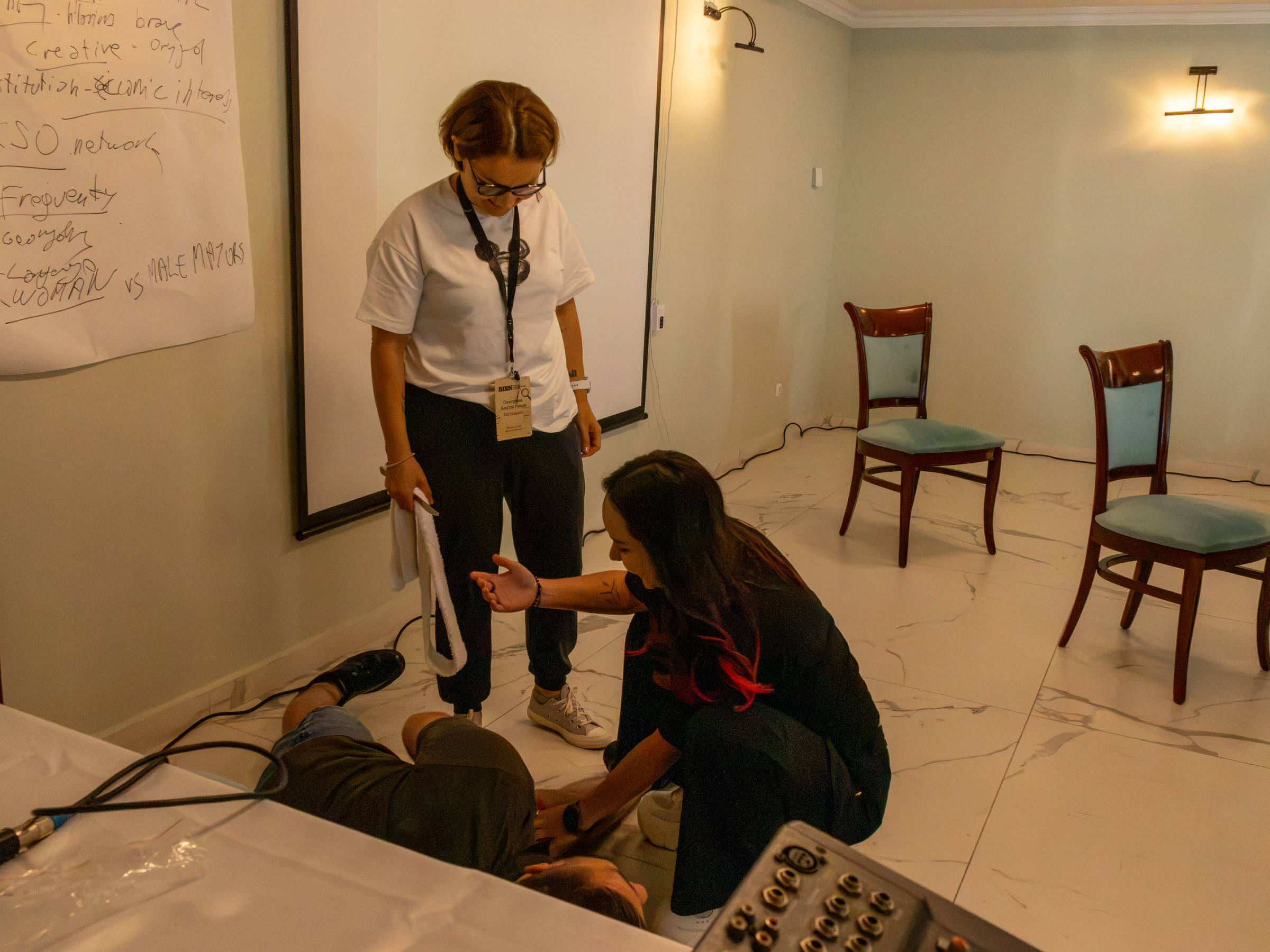
The third day ended with Sharbil Nammour’s scenario-based exercises and live problem-solving. Nammour showed how to help someone and save lives during unexpected situations, such as riots and protests, and how to provide first aid in the event of choking or bleeding.
“Be always active in this loop – observe, adapt and act. Most people freeze in such moments,” explained Nammour.