
by Aleksandra Vrbica
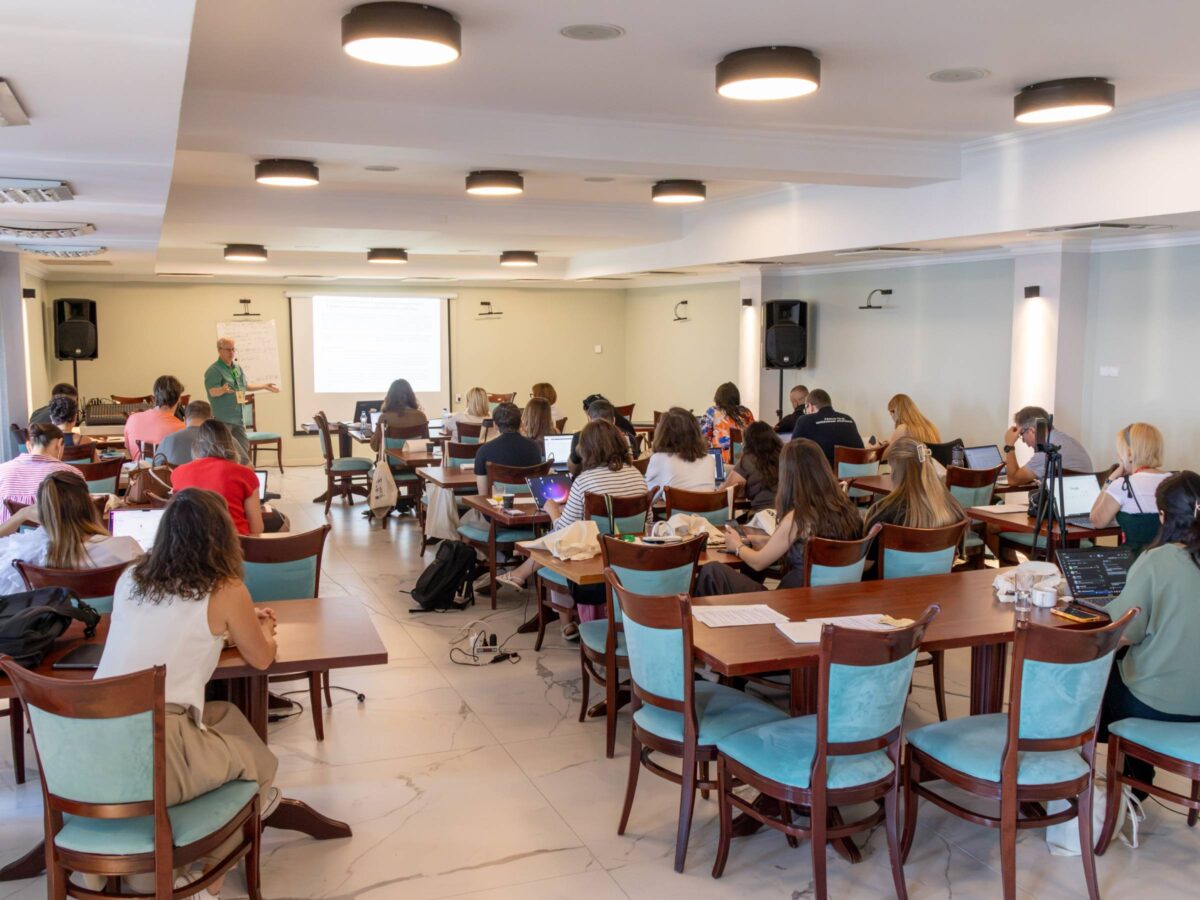
The first session of Day 4 of the BIRN Summer School in Ohrid started with BIRN consultant Alex Anderson’s session on policy-oriented investigative reporting.
Anderson recounted a two-week project he completed in Ukraine in 2014 titled “Ukraine must stop ongoing abuses and war crimes by pro-Ukrainian volunteer forces”. This was a quick-fire policy intervention report that required him to complete a seven-page report with a three-day turnaround from field to publication.
He also walked the participants through another project he did. Published with Human Rights Watch, his report “Leave None to Tell the Story” addressed genocide in Rwanda. The report was published five years after the events and was more than 600 pages long.

The day continued with a session on the Engaged Citizens Reporting (ECR) Programme, BIRN’s audience engagement tool. The session was led by Ana Petruseva, BIRN Macedonia Director, and Karla Junicic, Engaged Citizens Reporting Programme Coordinator at BIRN Hub.
“It can be created in multiple languages. Everything that people upload is encrypted, and one of the most important things ECR provides is digital safety,” Junicic said.
This tool is also used by other media outlets in the Western Balkans.

“We trained different media in the region to work with this tool. For citizens – this is a safe place, they don’t necessarily have to share their names if they don’t want to,” Petruseva added.
However, not every topic is an engagement topic.
“Some good topics for ECR are healthcare (for example, the waiting lists), daily evidence of corruption, environmental issues. It’s always important to do a pre-research and you should ask yourself – who is your stakeholder, what language are they using, and how to reach them,” explained Junicic.
She shared the BIRN investigation TikTok Used Across Balkans to ‘Slutshame’ Women and Girls with participants as a way of demonstrating how ECR can help in the investigation process. Through this tool, one of the victims left her contact information, which enabled the investigation’s author to interview her.

After Petruseva and Junicic’s session, Felicia Cretu, editorial fact-checker at CU SENS Media Project, held a session on fact-checking. She presented the checklist of what should be checked before the publication of an investigation: names, spelling, numbers and statistics, quotes, descriptions and any potential bias.
Cretu warned that using Wikipedia or media outlets that don’t fact-check as a source is something that can land journalists in trouble or result in a legal suit. “That’s why we verify every date, time period, time frame in the story,” Cretu said.
Together with participants, Cretu did an exercise from her organisation and showed all the steps she used to fact-check information.

The final session was on reporting on the environment, how to investigate pollution and the risks and impacts on public health.
Blake Morrison, lead trainer and investigative projects editor at Reuters News, discussed his investigation into the impact of pollution on children, a topic that was not sufficiently investigated in the United States at the time.
“First, I got two databases – the location of every school, and the location of every polluter in America. And I was looking for a school that the government had to close because it was so toxic. I found one near a plastic factory where the risk of getting cancer was 50 times greater than what was allowed by law,” explained Morrison. Later, he found more than 150 such locations.
The topic started a lively discussion with the participants, and the day ended with work on pitches that journalists will present on the final, sixth day of the summer school.